
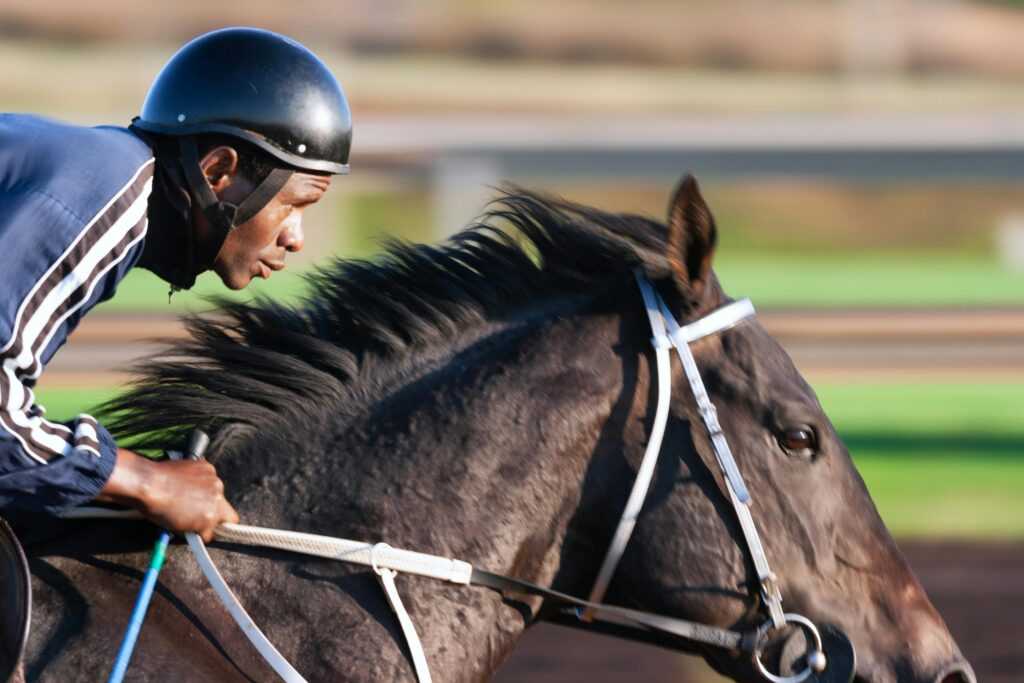
Most people perceive runners and jockeys as distinct creatures who belong to separate sports. One sport propels forward and runs on its legs, while the other is done on the back of an animal weighing over 500 kg; the rider must adapt as they ride on the back of the horse and remain balanced. However, as you study and become educated in both areas, you begin to see how many similarities there are between the two. Running and riding a horse have a similar foundation and support system that includes a combination of physical and psychological endurance, mental discipline, and controlled speed and pacing. All the great jockeys have trained like serious runners, while runners have so much to learn from a great jockey.
I have encountered both types of athletes. They are remarkably similar. Runners often describe having a rhythmic feeling of meditation and a heightened sense of awareness when they have managed to achieve a good stable pace. Jockeys will describe similar feelings despite the difference in mechanics. When horses are ridden, the jockey refers to feeling the horse, as the runner will describe with respect to the instinctual “cadence” or the speed which gets them to run the right speed. The communication between trained responses and intuition is one of the most critical aspects of training for both of these sports.
Although many believe they are not as extreme, the physiological requirements for elite jockeys are more similar to those of elite runners than most people realise. While horses do not run or travel the same race distance as elite long-distance runners, the effort an elite jockey exerts to maintain their balance while controlling and adjusting a horse travelling at speeds in excess of 35 miles per hour is extremely demanding. It is common for most elite jockeys to have a structured content running program to help them maintain an optimal trim body weight and aerobic capacity as well as enhance their explosive leg power; whereas elite runners could use the micro-adjustments jockeys make to control their horses during a race to develop the ability to react in fractions of seconds to changes in the athletic body of their opponents.
What has always fascinated me is how both groups study their competitions. Runners analyse split times and pacing patterns, while jockeys assess form, conditions and the rhythm of a race as carefully as any analyst. I have often heard riders discuss their preparation in ways that mirror the conversations I hear among distance runners. They compare trends, talk through tactical choices and adjust expectations based on variables beyond their control. Many even keep an eye on insights and changing information in the same way fans track horse racing odds when trying to understand the likely flow of a race, because the sport rewards those who recognise subtle shifts in performance before they become obvious to others.
The Discipline Behind the Craft
Running teaches discipline in its purest and least forgiving form. There are no shortcuts. You build strength, stamina and resilience through daily repetition, deliberate effort and an acceptance that success comes slowly. Jockeys live in that world too. Their training goes far beyond simply riding horses. Many run first thing in the morning, cross-train throughout the day and prioritise agility drills that would challenge even well-conditioned runners. Their weight management demands extraordinary self-control. Their cardiovascular routines mirror those used by middle-distance athletes.
Both runners and riders also practise refining technique under fatigue. Anyone who has run a hard interval session knows how form can deteriorate when the legs begin to burn. Jockeys feel that same shift during the closing stages of a race. The difference between maintaining posture and losing balance can determine whether the horse responds or resists. For both disciplines, technique under pressure is what separates the competent from the exceptional.
The Mental Game: Poise Under Pressure
Runners are also seen as having mental endurance, not just their physical endurance. Runners must overcome the mental hurdles of their self-doubt, fatigue, boredom, and race day anxiety. In the same way that runners experience these same mental challenges, jockeys also experience them in a much more extreme way; therefore, keeping relaxed while travelling on their horse in a field full of other horses, while controlling where we go by being able to anticipate where other riders will be positioned, and being able to respond on instinct to how our horse is acting.
All of these athletes learn that confidence, focus, and being able to regulate their emotions in stressful situations are all as important for jockeying as they are for running marathons. This is one of the reasons that both types of athletes will often use very similar mental techniques when training for competition, including the use of visualisation, pacing, breath control, and being able to quickly move back to the initial point of focus after something has gone wrong. A runner will often refer to a state of flow, while a jockey may refer to a quiet moment when everything around him is chaotic. Both of these experiences come from the same brain mechanism of controlled focus but differ in the way in which they were achieved.
Where the Two Worlds Meet
Spend time around a training yard in the early morning, then visit a running track later that afternoon, and you will see how similar the atmospheres feel. There is the same seriousness of purpose, the same understated conversations about form, the same blend of ritual and routine. The difference lies only in equipment and environment. What unites them is the athletic DNA that values patience, repetition, body awareness and strategic intelligence.
The relationship between horse racing and running is not accidental. In earlier times, running utilised to be one of the focus points for fitness development amongst successful jockeys because it required little equipment, provided real time feedback on performance and was the most effective way to build endurance. Even today, running continues to be incorporated by a number of successful jockeys as part of their weekly schedule for the same reasons mentioned above. This being said, runners have the opportunity to learn from successful jockeys by focusing more on developing their agility skills, strengthening their core stabilisation and focusing more on remaining calm under pressure when races get chaotic.
A Shared Understanding of Performance
There is something compelling about seeing two sports that appear unrelated reveal such a deep internal symmetry. Both rely on balance: physical, emotional and tactical. Both reward calm decision-making amid extreme stress.
The approach to success for both sports requires a keen sense of timing and rhythm in response to the betting activity of the crowd and other jockeys. In this way, runners and jockeys are united by their mindset rather than their methods. Both share a common heritage of endurance sports that rely heavily on intelligence in training, instinctive feelings, and reverence for the body’s resilience. Runners and jockeys continue to maintain an athletic legacy, whether on the track or on the turf, as they apply similar theories to their performance while pursuing excellence in their sport.